RemoteLogins Collection
The RemoteLogin object exposes the properties of a single login mapping record for connections to an instance of Microsoft® SQL Server™ that originates from another, known instance of SQL Server.
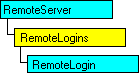
Properties
Methods
Remarks
Remarks
An instance of SQL Server can maintain authentication information for connections originating from other instances of SQL Server. Server-originated connections are attempted when, for example, remote procedure calls are part of a Transact-SQL script.
Each instance of SQL Server in an organization can control access by listing the servers it accepts connections from. For each of these remote servers, login-account mappings specify the local login used by a remote server connection when that remote server connects as part of a process run by the remote login.
With the RemoteLogins collection, you can:
- Map a login record on an instance of SQL Server to an existing login record on another instance of SQL Server.
- Remove a remote login record from the list of logins mapped for a remote instance of SQL Server.
To create a remote login
- Create a RemoteLogin object.
- Configure the RemoteLogin object by setting the RemoteName property to the name of a login on the remote (or connecting) instance of SQL Server.
- Configure the RemoteLogin object by setting the LocalName property to the name of a login on the local (or connected to) instance of SQL Server.
- Add the RemoteLogin object to the RemoteLogins collection of a RemoteServer object that references an existing remote server definition.
To remove a remote login
- Use the Remove method of the RemoteLogins collection as in:
oRemoteServer.RemoteLogins.Remove("stevenb")
When using the Item or Remove method, the RemoteLogins collection supports member identification using either name or ordinal reference syntax. For example:
Set oRemoteLogin = oRemoteServer.RemoteLogins("stevenb")
Or:
Set oRemoteLogin = oRemoteServer.RemoteLogins(2)
Note Creating or removing remote server login mappings by using the RemoteLogins collection requires appropriate privilege. The SQL Server login used for SQLServer object connection must be a member of the fixed role securityadmin or a role with greater privilege.